
For contractors and other project-based businesses, revenue under FRS 115 is earned as the work gets done, not when the contract is signed and not at handover. How you measure that progress therefore decides the profit you report each year. This article looks at the two methods FRS 115 allows, and what to watch for when you use them.
Download the newsletter (PDF, 6 pages)
1. When revenue is recognised over time
If your customer benefits as the work happens, such as a building going up on their own land, you recognise income gradually rather than all at the end.
FRS 115 lets you recognise revenue over time in three situations (paragraph 35). Your customer benefits as you do the work. Or the work creates an asset your customer controls while it is being built. Or the asset has no other use to you, and you have an enforceable right to be paid for the work done so far.
Once you choose a method, apply it consistently (para 40), and remeasure progress at every reporting date (para 43).
If you cannot yet measure progress reliably, revenue is limited to the costs you have incurred. That means no profit is shown until the numbers can be trusted (para 45).
2. Output or input: the main difference
The output method looks at what has been delivered. If the surveyor certifies the job is 60% built, 60% of the price is earned. The input method looks at what has gone in. If S$400,000 of an S$800,000 budget has been spent, the job is half done.
Output methods
Output methods (paras B15 to B17) measure the value handed over to your customer, such as quantity surveyor certifications, milestones reached or units delivered. They are easy to explain to a client. But certificates often trail behind the actual work, and milestones can leave long stretches where progress is not captured.
Input methods
Input methods (paras B18 and B19) measure the effort you have put in, most often cost-to-cost. Two adjustments apply. Costs that do not move the job forward, such as wasted materials or rework, are left out. And significant materials bought from a supplier but not yet installed earn revenue equal to their cost only, with no margin for simply buying them.
| Output method | Input method | |
|---|---|---|
| Question asked | What has the customer received? | What has the business put in? |
| Typical measure | QS-certified work done, milestones | Cost-to-cost, labour hours |
| Evidence | External certificates | Internal cost records and budgets |
| Main risk | Certificates lag the work; milestones are far apart | Budgets set too low; costs booked late or to the wrong project |
FRS 115 does not rank the two. The right method is whichever best reflects how control passes to your customer. In practice, most contractors use cost-to-cost, with QS certificates as a cross-check.
3. A worked example
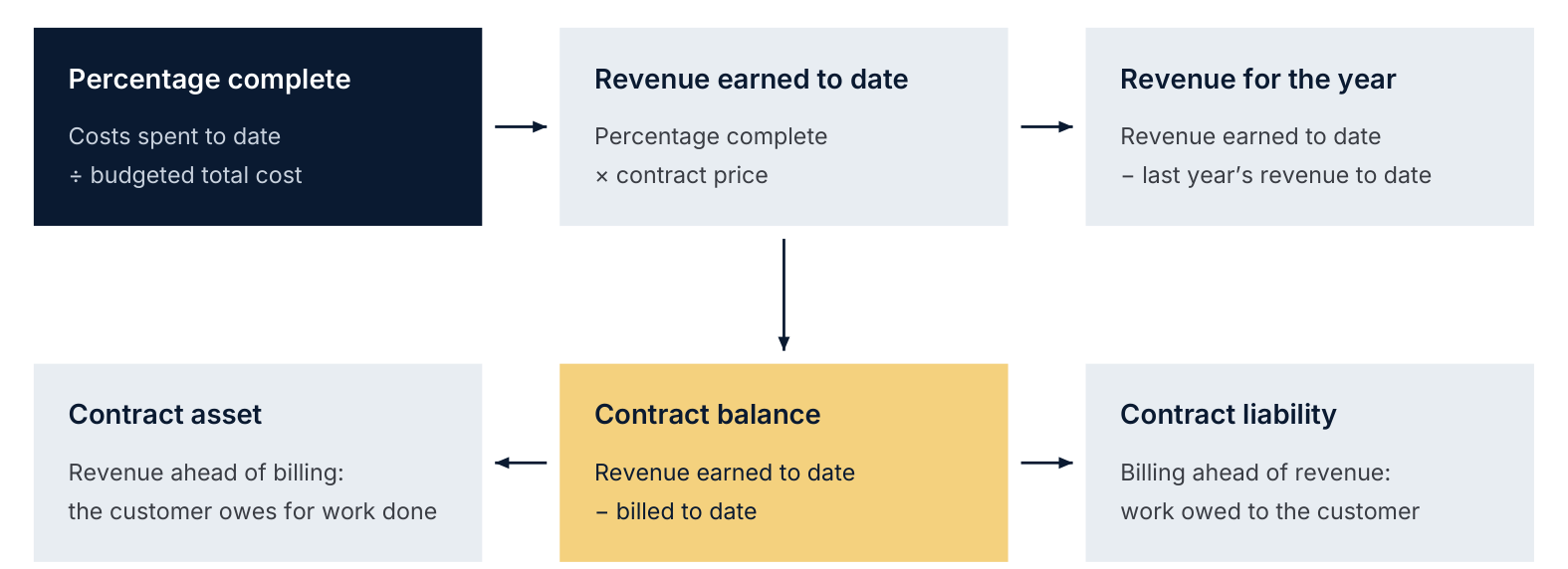
A contractor fits out a restaurant for S$550,000, including a S$50,000 variation order. It measures progress using cost-to-cost, and its financial year ends on 31 March.
| S$ | 31 Mar 2025 | 31 Mar 2026 |
|---|---|---|
| Budgeted total cost | 440,000 | 460,000 (revised) |
| Costs spent to date | 176,000 | 414,000 |
| Percentage complete | 40% | 90% |
| Revenue to date | 220,000 | 495,000 |
| Revenue for the year | 220,000 | 275,000 |
| Gross profit for the year | 44,000 | 37,000 |
| Billed to date | 165,000 | 517,000 |
| Contract asset / (liability) | 55,000 | (22,000) |
In 2025 the work ran ahead of the invoices, so the customer effectively owed S$55,000 for work not yet billed. That is a contract asset. By 2026 billing had overtaken the work, leaving a contract liability of S$22,000.
The cost estimate also rose by S$20,000 in 2026, which on its own cut that year's revenue by S$22,500. As a change in estimate under FRS 8, the whole catch-up falls in 2026, and the 2025 figures are not restated.
4. Why it matters
This one percentage decides the profit you report, what your customers owe you, and how quickly a loss-making job gets spotted.
Profit. On a S$5 million contract, every percentage point of progress that is misstated moves revenue by S$50,000.
Balance sheet. The wrong percentage throws off your contract assets and liabilities, and that can affect bank covenants.
Loss-making jobs. If a job is expected to make a loss, the whole loss is provided for as soon as it is identified (FRS 37). That needs an up-to-date cost estimate.
Audit. Revenue builds up from one year to the next, so weak records in one year affect the next year's figures, and can lead to a modified audit opinion.
This article contains general information only and is not professional advice. Please speak to a qualified adviser before acting on it.